Mosaic, with its charming appearance and dazzling colors, plays a fundamental role in world design and architecture, and when arranged together, it gives an extraordinarily attractive look to the decoration and urban environment.
Using mosaic in decoration requires great precision. Therefore, this task should be entrusted to individuals and professional teams.
Buying mosaic has been one of the most widely used building materials for centuries, not just today.
Now, what do we know about mosaic? What is its definition? Mosaic is a concrete flooring that is made in a mosaic factory through press pressure or vibration by combining materials such as sand, cement, stone aggregate, stone powder, additive colors, and water in various designs and dimensions. The prices of mosaics are relatively similar.
Mosaics are divided into two categories: single-layer and double-layer:
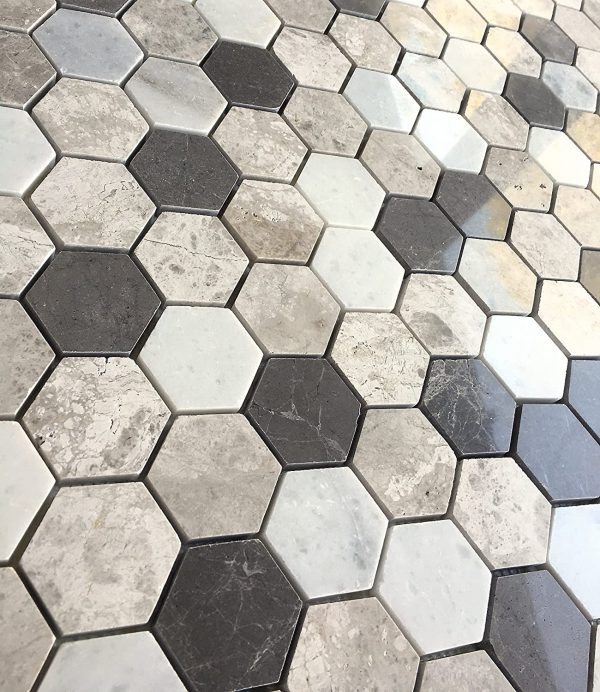
. Single-layer mosaic
This type of mosaic is low-volume (with a thickness of 18 mm) and, due to its low weight and beautiful surface, is mostly used inside buildings. Its features include high compressive strength, low water absorption percentage, a completely polished top surface, high diversity in design, color, and dimensions, and cardboard packaging at the mosaic factory. Despite the diverse designs and dimensions, the price of mosaic is approximately the same.
. Double-layer mosaic
It is actually a type of dense concrete that obtains its density through press pressure or vibration. In this case as well, the price of mosaic is approximately the same.
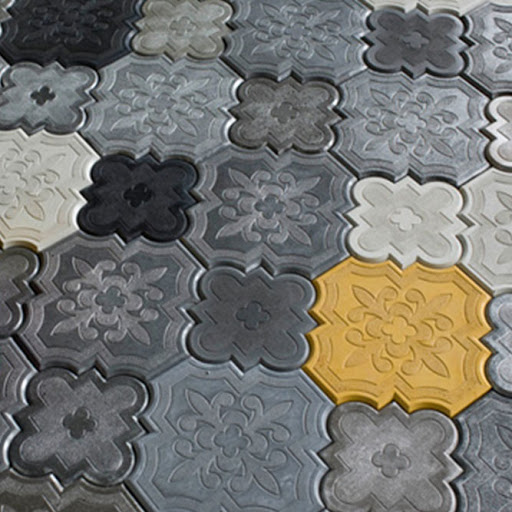
Mosaic consists of two surfaces:
1- Mosaic color or the top layer:
This layer, in which cement, water, stone powder, and graded colored compounds are used, forms the pattern of the mosaic.
2- Narin or the bottom layer:
This layer of the mosaic, like the top layer, is made of cement, sand, and water. It has greater thickness and the role of withstanding pressure is the responsibility of this layer.
A few lines above, we gave a brief explanation about mosaic production, stating that it is made by two methods: pressing and vibration. But how are these methods performed in the mosaic factory?
1- Making mosaic by the pressing method:
In this case, the use of a press machine causes pressure to be applied and density to be created in the mosaic. This pressure is variable and depends on the dimensions and the type of stone aggregates.
2- Making mosaic by the vibration method:
In this method, the operation of compaction and uniformization is done with the help of a vibration device, and there is absolutely no pressure. In this case, due to having a smooth and uniform surface, the mosaic does not need polishing (sanding). However, in some cases, vibration with the use of decorative stone requires the abrasion process.